Back

BOOTCAMP

Gaming Level Design

Become an expert in level design and discover the processes used in professional game studios to plan the pre-production of game environments and design levels in a methodical and organized manner.

DURATION
MODALITY
TIMETABLE

6 months / 300H

Live online

6:30 p.m. – 9:30 p.m. (2 days / week)

LEVEL
SQUARES
BEGINNING

Advanced

12

April

Learn fundamental aspects such as the theory and application of level design techniques, from conceptualization to on-level implementation of specific mechanics for different game genres.

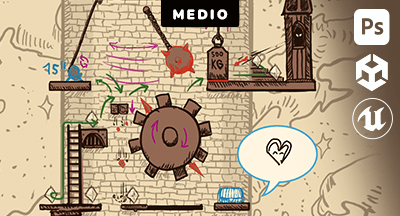
Software used

Bootcamp methodology

We use a methodology focused on practice and building a strong portfolio:

Lectures

Practicing theory is not just a complement, but the heart of your learning. Our hands-on approach is designed to consolidate your learning, boost your creativity and hone your technical skills, preparing you to excel in the industry.

Collaboration with incubator teams

At the end of the bootcamp, you will have the option to apply the theory learned in live projects and collaborate in one of the teams of our incubator. This experience will provide you with an understanding of the dynamics of teamwork, problem-solving, and business project development.

Bootcamp Final Project

Throughout the bootcamp, a final project will be carried out with mentored follow-up so that when you complete it you will have a project that will serve as a portfolio for the job search.

Careers

You will have access to 40 hours dedicated to professional careers, where we will teach you how to define and create a good portfolio and curriculum based on your specialty. In addition, we will provide you with guidance to professionally communicate your CV profile and highlight all your strengths effectively, thus preparing you to face the selection processes with more tools.

Program

We will learn design theories applied to video games. We will address pacing and rhythm in the design of levels, verticality and exploration in navigable space, as well as the design of spaces for stealth and exciting encounters. In the design of multiplayer levels, we will analyze flow and connectivity, map balance and the creation of dynamic points of interest. We’ll also compare Unreal Engine and Unity for level design, highlighting the advanced use of BSP and Static Meshes, as well as ProBuilder. Finally, we will learn prototyping techniques and efficient blocking out in Unreal and Unity to optimize our workflow.

We’ll explore Unreal Engine and Unity tools. At Unreal, we’ll focus on advanced blueprints and visual logic, as well as lighting and materials for level designers. We will also address optimization and performance to ensure efficient projects. In Unity, we’ll dive deeper into advanced C# scripts and visual logic, as well as lighting and level design materials. We will also focus on optimization and performance to ensure optimal performance. In addition, we will learn rapid prototyping techniques, including whiteboxing, rapid iteration, and adjustment based on player feedback on both platforms. These skills will enhance our ability to develop high-quality games on both engines.

We will see different types of levels in video games. In combat levels, we’ll learn how to design effective arenas and combat spaces, balance encounters and checkpoints, and implement cover systems for dynamic gameplay. In stealth levels, we’ll create routes and options for the player, leveraging lighting and sound, and integrating surveillance patterns and AI to challenge the player. In exploration levels, we will differentiate between open and linear worlds, design points of interest and rewards, and facilitate the player’s navigation and orientation. Finally, in puzzle levels, we will structure puzzles, integrate specific mechanics, and consider their narrative impact.

We will learn playtesting and publishing strategies. We will organize testing sessions to obtain data and feedback, then analyze this information to guide the iteration of our project. On the post and community side, we’ll identify suitable platforms for public testing, engage with the community to gather feedback and suggestions, and use this feedback to make updates that improve the user experience. These practices will allow us to refine our projects and build positive relationships with the gaming community, ensuring a successful launch and active participation in the gaming community.

We will look at environmental storytelling and mission design in video games. We will integrate the story into the spatial design, using dynamic narrative elements to immerse the player. We will create events and quests that impact the narrative of the game. In mission design, we’ll develop structures for main and side missions, incorporating pivot points and climax moments to keep the player engaged. In addition, we will implement narrative feedback and rewards to enrich the player experience and motivate their active participation in the game’s plot. These techniques will improve immersion and player satisfaction.

We will address scripting and automation in video game development. We’ll use blueprints in Unreal Engine to create visual logic without programming. In Unity, we’ll become familiar with C# to develop complex, custom systems. In addition, we will learn how to automate repetitive tasks to improve efficiency in development. These skills will allow us to streamline processes, optimize workflow, and focus on creativity and iteration instead of tedious tasks, thus improving the quality and development time of our games.

We will build a professional level designer portfolio. We will learn how to select and present projects, highlighting the detailed documentation and clear description of each one. In addition, we will develop strategies to showcase our work online, maximizing its visibility. In presenting projects to the community, we will prepare for public demos and betas, communicating updates effectively. We will collect and use community feedback to continuously improve our future projects, thereby strengthening our presence in the game development industry.

Detailed agenda

Receive the complete syllabus of this training, price and details of financing and registration.
 

Advantages

Expertly designed topics

All our syllabuses have been prepared by professionals in the sector who understand the demands of companies for each specific job profile.

Recorded classes

All classes will be recorded and available on our campus so that if one day you cannot attend class, do not miss the opportunity to take it at another time and you can be up to date with everything.

Updated curriculum

Thanks to the fact that we are a private school and that our own teachers are professionals in the sector, every year we update the contents of our training with the latest demands of the sector.

Online training

Classes are held online and in real time, with teacher and students connected in the same room, seeing and communicating with each other. This format is very common in large video game development companies that have teams distributed around the world, therefore, it is an excellent way to prepare for the work environment.

Real Incubator Project

Thanks to our outstanding incubation program, Level Up students have the unique opportunity to collaborate on selected teams that have emerged from our incubator. This quality experience allows them to be an active part of real projects in multidisciplinary teams, thus expanding their experience and skills.

Professional teachers

In order to offer specialised and up-to-date training, we work with professionals in the sector who are part of our team of teachers and are connected to the industry and know first-hand the knowledge needs that each professional profile requires.

Request information


[integrate_google_drive id="1"]


[pmpro_login]

×